

What is Istehadha?
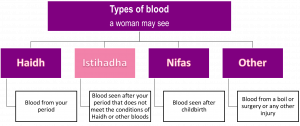
Istehadha is a type of blood seen by women where the discharge is irregular.
Verification of blood being Istehadha
If the blood seen does not meet the conditions for any other types of blood, it is istihadha.
Signs of Istehadha
Blood seen at the time of istihadha usually has its own distinctive features:
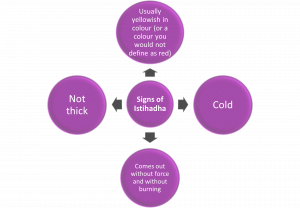
Note: However, there are always some exceptions. A woman may see istehadha blood that is red or dark, thick; warm or that comes out with force and burning.
Types of Istehadha
After one verifies that the blood seen is istehadha, the next step is to know what type of istehadha it is, as the rules differ for each type. To determine what type of istehadha it is, one must place cotton on the surface of the vagina and see how much blood soaks the cotton. Below are the three different types of istehadha one will determine after the test:
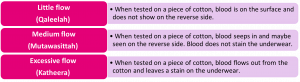
Note: The best way to examine the type of istehadha is on a piece of cotton, because on a sanitary pad the blood is absorbed and has a plastic base to avoid leakage. Hence, to determine the type of istehadha cotton should be used.
Rules of Istehadha
Having determined the type of istehadha, there are now different rules for the different types of blood. We have already talked about how to determine the type of istehadha blood above.
Rules for Little Flow (Qaleelah)
- Wash the surface of the vagina
- Change the cotton (pad)
- For each prayer perform one new wudhu (ablution)
Note: All other kinds of worship where wudhu is necessary require a new wudhu. What this means is if a woman has made wudhu for one salat and if she decides to perform another kind of worship she needs to start from Step 1. Further explanation: If a woman sees a little discharge of blood and as per the signs and verification, she is sure its istehadha, then for performing each prayer she should wash the surface of her vagina, change the cotton and perform Wudhu.
Further Notes:
- To prevent the blood from gushing out, let the cottonstay in vagina. If the blood comes gushing out in the midst of the prayers it will be deemed void.
- Let the cottonstay in vagina. Between 2 prayers examine it; if no blood is seen, renewing the Wudhu is not necessary.
Rules for Medium flow (Mutawassitah)
- Do the 3 steps of Qaleelah
- For the first prayer (recited after the woman sees blood) perform ghusl, and after that perform ghusl every day before each morning prayer.
Note:Its wajib to do wudhu again for the other acts of worship that require wudhu.
Further explanation: If a woman sees medium discharge of blood, and as per the signs and verification she is sure it is istehadha, then, for performing each prayer she should wash the surface of her vagina, change the cotton and perform Wudhu and in addition perform ghusl if it is the first salat of the day.
From the next day in addition to doing the 3 steps of Qaleelah, she should (1) Perform ghusl for the morning prayers only, (2) Should wash the surface of the vagina and change the cotton and do wudhu for each prayer.
Rules for Excessive flow (Katheera)
- For each prayer perform one ghusl.
- Do the 3 steps of Qaleelah.
Note: If praying Asr right after Dhuhr or Isha right after Maghrib, only 3 ghusls are enough for the day. (One for Fajr, one for Zuhr and Asr, and one for Maghrib and Isha) However, between Dhuhr and Asr, Maghrib and Isha she must wash, change the cotton and do wudhu.
Important Note: As per Ayatullah Seestani wudhu is not needed after the ghusl but if a woman wishes she should do it before ghusl for Katheera. Whereas, Imam Khomeini says wudhu is required.
Change of Intensity of Blood Flow
When one sees the intensity of the blood flow increase, then there are different rules that apply:
Change of Flow from Less to More
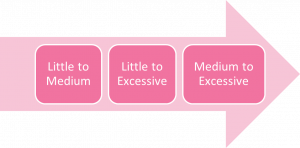
In other words one of the following:
- Qaleelah to Mutawassitah (Little to Medium flow)
- Qaleelah to Katheera (Little to Excessive flow)
- Mutawassitah to Katheera (Medium to Excessive flow)
Rules to be followed if the blood flow changes from less to more as stated above:
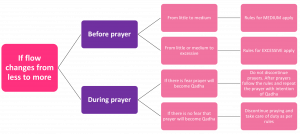
Note: For explanation of rules for little flow, medium flow and excessive, refer to the rules of istehadha.
Further explanation: If a woman starts praying and realizes that the blood flow has increased then she should see if there is enough time left so that her prayers do not get Qadha. If there is enough time left then she should discontinue her prayers.
After discontinuing her prayers she should check to see if the flow has increased to medium or excessive istehadha, and then follow the rules accordingly.
If there is not enough time left, then she should not discontinue the prayers. She should complete the prayers, then check to see if the intensity of the flow increased to medium flow or excessive flow. Follow the rules accordingly, and then repeat the prayer again with the intention of Qadha.
Change of Flow from More to Less
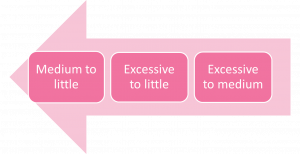
In other words on of the following:
- Katheera to Qaleelah (Excessive to Little)
- Katheera to Mutawassitah (Excessive to Medium)
- Mutawassitah to Qaleelah (Medium to Little)
Rules to be followed if the blood flow changes from more to less as stated above:
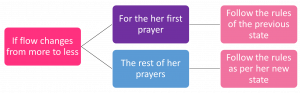
Rule: For the first prayer, a woman should follow the rules as per the state she was in. Prayers after that are going to be as per the state she is in.
Further explanation: If a woman is in the state of Katheera (Excessive flow) and before praying Dhuhr she realizes that she is in the state of Qaleelah (Little) now, she should follow the rules for Katheera for praying Dhuhr and then for Asr she should follow the rules for Qaleela.
If a woman after Dhuhr realizes that state she is not in a state of Katheera anymore but she is in a state of Qaleela now, she should still follow the rules for Katheera for praying Asr and then for Maghrib and the prayers after that she should follow the rules of Qaleela.
Types of Women
Allah (swt) has created everyone different. In order to help women find the correct laws regarding their specific situation, women are classified into categories. Each category has certain rules that need to be followed.
We can classify women into 4 categories:
- Beginners (Mubtadi’ah) – like a girl who sees menstruation for the first time. After a couple of days the beginner will find out what following category she belongs to.
- Women who have a certain habit mainly categorized by when a women gets her period and for how long she gets her period (Zaat-ul-Adah)
- Women who have irregular cycles (Muztaribah) – women without any habits.
- Women who are forgetful (Nasiyah)
In other words, women can have three kinds of habits or no habits at all and in order to be considered in one of these categories, a woman must experience the pattern for two months in a row.
Rulings and scenarios for different types of women:
Beginners (Mubtadiyah) Women of Habit (Zaat-ul-Adah) Women who have irregular cycles (Muztaribah) Women who are forgetful (Nasiyah)Fasting during Istehadha
Women are allowed to fast during the state of istehadha, which means that once the haidh/period is over, women are obliged to fast just as they are obliged to pray regularly.
In order to fast during istehadha, a woman should follow all the rules stated according to the kind of istehadha she is experiencing, and that is what affects the validity of the fast when it comes to istehadha. The woman should do her ghusuls and whudhu accordingly as stated in the rules, and prevent the blood from gushing out by using a cotton.
Note: Ayatullah Seestani says that it is not a problem if the blood gushes out during the fast, and the fast is valid, but she must prevent the blood from gushing out of her vagina during her prayers.
Miscellaneous Points regarding Istehadha
- According to Ayatullah Seestani if a woman is not sure if she is in a state Mutawassitah or Qaleelah she should consider it as Qaleelah. Another scenario would be if a woman is not sure if she is in a state of Katheera or Mutawassitah. In this case she should consider it to be Mutawassitah. In other words when in doubt she must always go with the lesser one.
- If a woman delays her prayers thinking that her istehadha will stop before the salat becomes Qadha, then it is okay to do so as long as she does not delay her prayers so long that they become Qadha.
- Salatul Ayat is the prayers that are obligatory at the time of natural calamities for example, an earthquake, a lunar eclipse, or a solar eclipse etc. Salatul Ayat is obligatory on a woman who is experiencing istehadha. All the rules required for a woman in istehadha during the other obligatory prayers are also required for this salat. (Please note: Same rules apply for all the obligatory prayers.)
Related:
Ghusul