
Signs of Haidh
When trying to distinguish whether or not the blood you see is your period or not, there are a couple of signs that you could look for:
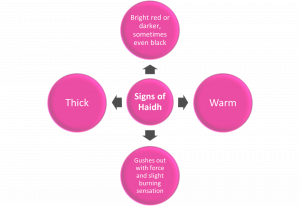
Conditions of Haidh
In order to make sure that the blood you are seeing is in fact from your period, you must do a few calculations. It is recommended that girls keeps a separate calendar for themselves, and record whatever they see going on in order to help them follow the proper laws.
Here are the conditions that you can check off one by one to make sure the blood you see is from Haidh:
- The blood seen is not less than 3 days
- The blood is seen for 3 days in a row
- Continuous flow of blood for 3 days
Note: In the beginning of the cycle (in some cases) blood is visible, later exists internally (for a few days in the vagina) and after some time it starts flowing again. (Meaning if you know that there is blood inside -which may be tested by using a tissue- even if it does not flow onto your pad, the blood is still flowing.)
- The total duration in not more than 10 days (If it is more than 10 days, refer to the Istehadha section)
- You must be older than 9 years according to the lunar calendar (approximately 8 ½ years solar calendar)
- A woman must see the blood before she goes through menopause. (Menopause: The time when women get older and stop seeing blood – Which may be around the age of 60 for Sayyid Women (Women from the progeny of the Prophet) or the age of 50 for Non Sayyid women as per the lunar calendar, as per Islamic Laws.)
- Between 2 cycles of menstruation, there should be at least a 10-day gap. So if you were to look at your calendar, there should be 10 days of clean between 2 periods.
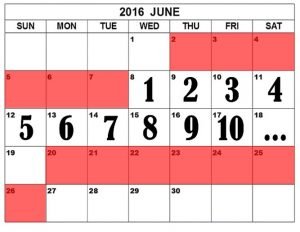
Note:
- In the example shown above, in the first period 6 days have been shown and in the second 7 days have been shown to demonstrate that not all women have their period for the same amount of days every time.
- The days showed in between the two periods are more than 10 to show that it does not have to be exactly 10 clean days in between. Some women may experience exactly 10 days, others 20 and some with complications may even experience a month or more.
Things that are not allowed during periods:
- Any kind of worship for which wudhu is required, for example:
- Salat (Salat missed during Haidh does not have to be made up for)
- Fasting (Fasts missed during Haidh must be made up for)
- Tawaaf of Ka’aba
- Sex
- It’s Haram to enter Masjid ul Haram and Masjid un Nabi.
- Stopping in other mosques and the shrines of Imams is Haram. (Passing through one door and coming out through another door is okay as long as one does not stop inside.)
- Placing something in the mosque is Haram, but picking up something is no problem, according to Imam Khomeini. However, as per Ayatullah Seestani a woman cannot place or pick up something from a mosque.
- It’s Haram to touch the words of Qur’an with any part of the body.
- It’s Haram to touch the names of Allah in any language.
- It’s Haram to touch names of Prophets and Imams and Syeda Fatema (SA).
- Reciting 4 surahs that contain the Wajib Sajda is Haram: Surah Sajda, Surah Fussilat, Surah Al-Najm and Surah Al-Alaq.
Note: According to Imam Khomeini, even reciting one word of the surahs mentioned above is haram. Ayatullah Seestani says that reciting the Surah is not a problem one should not recite the ayats that have the Sajda e wajib in them. Surah Sajda Ayat 15, Surah Fussilat Ayat 38, Surah Al-Najm Ayat 62, and Surah Al-Alaq Ayat 19.
One common misconception is that women on have is that while on their period they are not allowed to recite the Holy Quran. The only thing prohibited is touching the words of the Holy Quran and reciting the Surahs mentioned above that contain the 4 wajib sajdas. Other than that, it is perfectly fine to recite the Holy Quran during your period. Just remember not to touch any of the words, for instance by putting a tissue under your hand while touching the page etc.
Note: These acts are common between a woman who is on her period or someone who has not done ‘ghusle janabat’ (A ghusl that must be performed after having sex or any act that results in an orgasm for men and women)
Types of Women
Allah (swt) has created everyone different. In order to help women find the correct laws regarding their specific situation, women are classified into categories. Each category has certain rules that need to be followed.
We can classify women into 4 categories:
- Beginners (Mubtadi’ah) – like a girl who sees menstruation for the first time. After a couple of days the beginner will find out what following category she belongs to.
- Women who have a certain habit mainly categorized by when a women gets her period and for how long she gets her period (Zaat-ul-Adah)
- Women who have irregular cycles (Muztaribah) – women without any habits.
- Women who are forgetful (Nasiyah)
In other words, women can have three kinds of habits or no habits at all and in order to be considered in one of these categories, a woman must experience the pattern for two months in a row.
Rulings and scenarios for different types of women:
Beginners (Mubtadiyah) Women of Habit (Zaat-ul-Adah) Women who have irregular cycles (Muztaribah) Women who are forgetful (Nasiyah)Different Types of Menstruation
Type 1: This woman is clean the whole month, only sees blood during the days of menstruation.
Type 2: This woman sees blood (spotting) the whole month, but during the days of haidh, the blood has signs of haidh.
Type 3: This woman is clean the whole month, but during the days of haidh, she sees blood for a couple of days, then there is no blood for a day or two, then she sees blood again. If this routine continues for 10 days then it is all haidh.
Note: This is as per Imam Khomeini. As per Ayatullah Seestani the days in between haidh when one does not see blood should be considered as ‘Jum`or Jamaa (Ihtiyat-e-Wajib) (https://www.al-islam.org – This page has been compiled using material from al-islam.org)