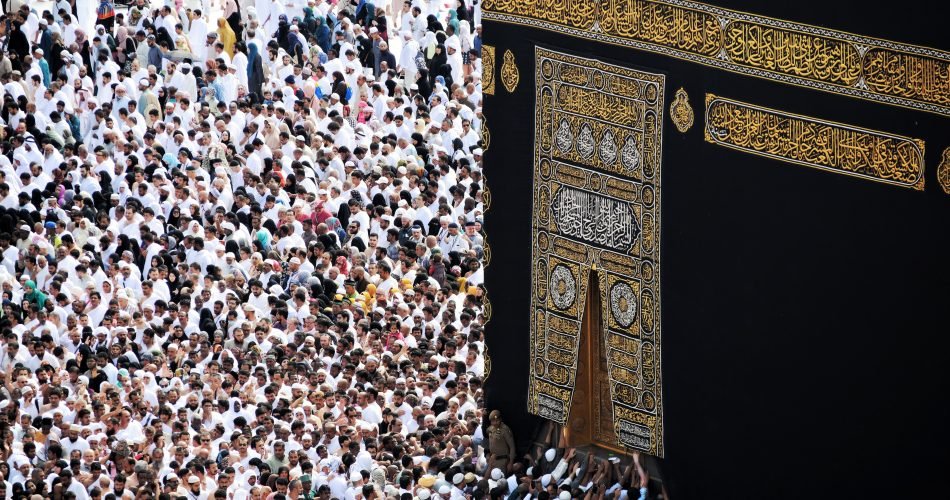
Here are some words that are frequently used when we speak about Hajj (Pilgrimage):
Haji: A Haji is the person who is performing Hajj.
Mustati: Someone upon whom Hajj has become wajib (obligatory). This means that all the conditions of Hajj apply to them. Once all the conditions of Hajj apply to someone, they are considered a “Mustati” until they have performed Hajj. In other words, once Hajj has become wajib on someone, it will remain wajib upon them until they perform Hajj (even if their situation changes).
Umrah: An Umrah is act of worship that consists of Ihram, Tawaf, Prayer of Tawaf, Saai, and Taqseer. An Umrah can be performed anytime of the year, however that Umrah will not be part of Hajj. The Umrah for Hajj is a part of the Hajj journey and must have the intention of Umrah for Hajj.
Ihram: A type of clothing that must be worn during Umrah or Hajj. The ihram is made up of two pieces of unstitched cloth for men, while women can wear anything sufficient for hijab. The ihram is not just a physical garment, rather it is a state. The state of ihram starts at certain places and at certain times with an intention. There are many things forbidden in this state (for example it is forbidden to: wear stitched clothing (for men), looking in the mirror, killing any living thing, using perfume, etc.). Someone in the state of Ihram is called a Muhrim.
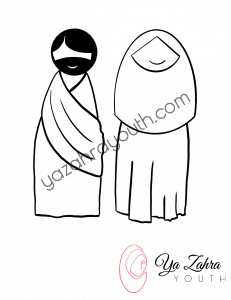
Figure: Ihram
Tawaf: Tawaf means to go around and refers to circling the holy Kaaba anticlockwise seven times. A two unit prayer of tawaf also accompanies the tawaf.
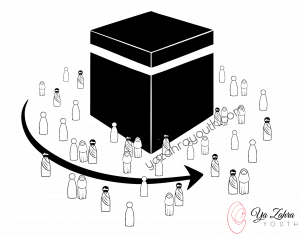
Figure: Tawaf
Tawaf-un-Nisa: This tawaf is an obligatory tawaf that must be performed towards the end of Hajj or Umrah, and a husband and wife cannot be intimate with one another until this tawaf is complete. A two unit prayer of tawaf also accompanies the tawaf.
Saai: Saai means “to walk” and refers to walking back and forth seven times between the hills of Safa and Marwa located near the holy Kaaba (Walking from Safa to Marwa counts as one time, and walking back from Marwa to Safa counts as two times, and so on). Saai commemorates the walking (and running) back and forth of Hajar (SA) (wife of Prophet Ibrahim (AS)) when she was searching for water for her baby Prophet Ismail (AS).
Halq: Halq means to shave the head, which is done by men to exit the state of Ihram in a wajib Hajj.
Taqseer: Taqseer means to cut a small amount of hair or nails to exit the state of Ihram. This can be done by women in a wajib Hajj, or by anyone performing a mustahab Hajj or Umrah.
Qurbani: Qurbani refers to sacrificing an animal.
Wuqoof: Wuqoof means to “to stay”, and the term is usually seen alongside one of the many places we visit during Hajj. For example, “Wuqoof-e-Arafaat” meaning to stay in the plains of Arafaat.
Rami-Jamarat: Means to stone the “Shaitans” seven times each. These “Shaitans” are three stone pillars in Mina, and stoning them is symbolic of remembering of what Prophet Ibrahim (AS) went through when he was ordered to sacrifice his son Ismail (AS). The three pillars symbolize the three places where Shaitan appeared to the Prophet (AS) to tempt him to stop the sacrifice, and each time the Prophet (AS) threw stones at him and moved on. The three pillars are known as:
- Jamarah al-Aqaba or Jamarah al-Kubra (the big pillar)
- Jamarah al-Wusta (the medium or middle pillar)
- Jamarah al-Ula or Jamarah al-Sughra (the small pillar)